
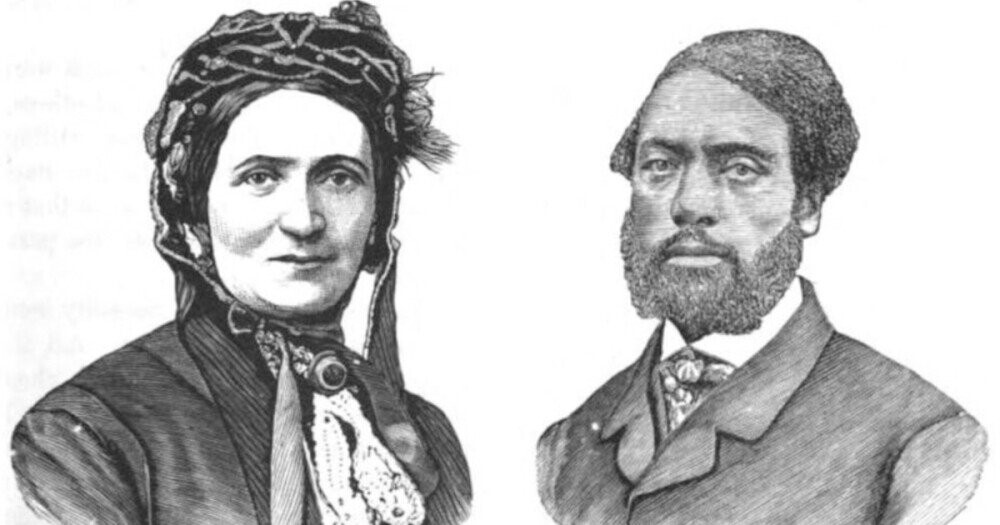
But the constant fear capture was too much, and the Crafts decided once again to flee — this time to England. “It was not until we stepped ashore at Liverpool that we were free from every slavish fear,” William wrote.
They settled in Ockham, Surrey, where they attended school and connected with the British abolitionist movement. They gave many public lectures on slavery in the U.S., and Ellen turned their home into a hub for Black activism in England, hosting multiple visiting and touring abolitionists. She also participated in the women’s suffrage movement and was known for her sharp wit and observations and ability to effectively criticize politicians with racist beliefs.
When some pro-slavery propagandists suggested she regretted her escape, she wrote: “I have never had the slightest inclination whatever of returning to bondage; and God forbid that I should ever be so false to liberty as to prefer slavery in its stead. In fact, since my escape from slavery, I have gotten much better in every respect than I could have possibly anticipated. Though, had it been to the contrary, my feelings in regard to this would have been just the same, for I had much rather starve in England, a free woman, than be a slave for the best man that ever breathed upon the American continent.”
The Craft Legacy
In all, the Crafts spent 19 years in England and had five children. After the Civil War, Ellen was also able to locate her mother, Maria, back in Georgia and paid for her passage to England, where, after many years, they were reunited. In 1860, they co-authored the aforementioned Running a Thousand Miles for Freedom. Not only does the book tell the story of their escape, but it also served as a compelling reflection on the fluidity of race, gender, and class, concepts that were considered concrete and immutable in the 19th century.
The Crafts, along with three of their children, returned to the U.S. in 1868, where they opened the Woodville Co-Operative Farm School for newly freed men and women in Georgia in 1873, though the school closed only five years later amid some legal trouble. They finally moved to Charleston, South Carolina, to live with their daughter. Ellen Craft died in 1891, and William died in 1900. Today, their legacy still lives on, not just because of their brilliant, daring escape but also their social and political activism and dedication to eradicating slavery and racism.
Recently, a plaque was unveiled in Ockham, England, where their great-great-great grandson, Christopher Clark, now in his 70s, still lives. On the unveiling of the memorial, Clark said, “I like to think that if people are thought of and spoken about, they still in some respects live amongst us … and I would like to thank William and Ellen for what they strove for and what they achieved.”


0 Comments