
If the hentai/furry porn-fueled demise of GETTR, the social media platform designed by one of President Trump’s former aides, wasn’t enough to illustrate how unmoderated free speech isn’t always a good thing (unless you’re into some really kinky stuff and/or love pissing off QAnon), the far-right evidently remains undeterred in their never-ending quest to stick it to big tech, launching a new gadget called the “Freedom Phone.”
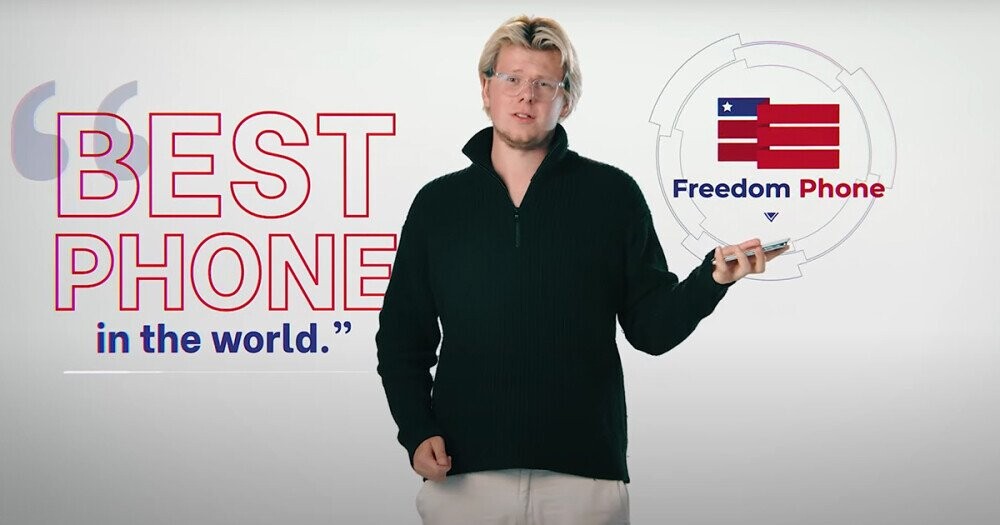
Despite sounding like a bad SNL commercial peddling a mobile device that doubles as a gun and a koozie for your 44oz Slurpee, the Freedom Phone is so, so much weirder, promising an escape from Silicon Valley’s “spying” and “censorship” for the (not so) low, low price of $499. The brainchild of 22-year-old Bitcoin millionaire, Erik Finman, the device, which launched earlier this week, touts itself as “a free speech and privacy first focused phone,” per its web listing. Complete with an “uncensorable app store” called the PatriApp, and several pre-loaded popular right-wing apps, including Parler, Rumble, and Newsmax, users can also get their QAnon content fix from the moment the phone emerges from its (presumably) red, white, and blue box.
“This is the first major pushback on the Big Tech companies that attacked us – for just thinking different,” Finman wrote on Twitter alongside a video detailing the project. “We’re finally taking back control,” he added.
Despite the entrepreneur’s claims that the device is “comparable to the best smartphones on the market,” venturing to call his product “truly is the best phone in the world,” some news outlets have brought into question how free the Freedom Phone may actually be. In the days since its release, a handful of reports have emerged alleging the device is actually a “budget phone from Asia that may end up compromising buyers’ autonomy rather than protecting it,” as Gizmodo‘s Lucas Ropek put it.
Aside from citing the fact that the Freedom Phone’s listing offers approximately zero specs about any of the phone’s features, merely naming its offerings next to a massive “Buy it Now” button, a factor that Ropek says “makes it a potential security (and thus also privacy) nightmare,” experts too, are also seemingly wary of the device.
“Based on photographs from the company website a number of Internet sleuths identified that the device has the same form-factor, shape, and appearance of a Umidigi A9 Pro,” Matthew Hickey, co-founder of Cyber House, told the tech outlet via email. “This device is a drop-shipped customizable Android-based phone that can be ordered from ASIAPAC region and customized to a project’s requirements,” he said. Hickey also noted that these devices can be “bought and shipped in bulk with custom logos and branding so as to give the appearance of a phone that has been designed for a unique purpose but is actually just a common cheap Android-based smartphone with core components produced in Taiwan and the surrounding areas.”


0 Comments